


Discussions around emissions from deforestation often focus on what is most visible: how many hectares were lost, how forest cover declined, and how much carbon was released from burning vegetation.
Yet in peatland landscapes—including parts of Papua, Indonesia—some of the most consequential emissions are not immediately visible above ground.
Peatlands store carbon not only in trees and plant biomass, but deep within the soil itself. This carbon has accumulated over thousands of years under water-saturated conditions. When peat dries and burns, fire does not only consume surface vegetation. It can smoulder underground for extended periods, releasing large volumes of carbon long after flames disappear from view.
This distinction matters for how emissions are understood, measured, and managed.
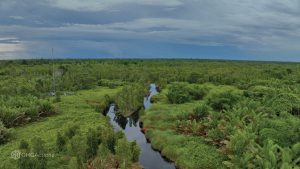
Recent national data highlights the imbalance between burned area and emissions in peatland fires.
Based on official reporting from Indonesia’s Ministry of Environment and Forestry (KLHK), as summarized by SWA Magazine, forest and land fires between January and September 2024 generated an estimated 41.2 million tonnes of CO₂-equivalent emissions nationwide. Of this total:
- Approximately 11.59 million tonnes CO₂e originated from below-ground peat combustion, and
- About 29.61 million tonnes CO₂e came from above-ground biomass and fires on mineral soils.
During the same period, peatland fires accounted for only about 8.88% of the total burned area, yet they contributed nearly 28% of total fire-related emissions, driven largely by carbon released from peat soils.
This disparity illustrates what is often referred to as “hidden emissions”—emissions that are more difficult to detect, measure, and communicate, but which carry significant climate implications.
Hidden emissions from peat fires pose challenges not only for environmental protection, but also for carbon accounting, national climate commitments, and market credibility.
Where peat is present, focusing solely on above-ground vegetation loss risks underestimating total emissions exposure. In such landscapes, a single dry season can result in emission releases that offset years of gradual carbon gains, particularly if peat hydrology has been disturbed.
From a climate perspective, this has implications for:
- the robustness of national greenhouse gas inventories,
- the credibility of jurisdictional and landscape-level climate programs, and
- long-term emission reduction trajectories tied to land-use sectors.
The implication is clear: preventing peat fires is not only a matter of fire suppression—it is central to emission integrity.
In peatland landscapes, reducing emission risk depends on:
- maintaining peat hydrology to prevent drying,
- strengthening early warning and monitoring systems, and
- embedding fire prevention within broader land-use planning and community engagement.
For organizations engaged in climate mitigation, forest management, and carbon-related activities, this underscores the importance of addressing underlying risk conditions, not only visible outcomes.
This perspective informs GHG Actions’ emphasis on emission integrity and risk prevention—supporting approaches that reduce the likelihood of peat degradation and fire, thereby avoiding sudden, high-impact emission releases that can undermine long-term climate goals.
- SWA Magazine (2024). Kementerian LHK Kendalikan Karhutla, Titik Panas Turun 59% Summary of official KLHK data on forest and land fires, burned area, and emissions (Jan–Sept 2024).
https://swa.co.id/read/451790/kementerian-lhk-kendalikan-karhutla-titik-panas-turun-59 - Indonesia Ministry of Environment and Forestry (KLHK) — SiPongi System National forest and land fire monitoring and emissions reporting.
https://sipongi.gakkum.kehutanan.go.id/ - Pantau Gambut (2023). Kebakaran Hutan dan Lahan di Tanah Papua Assessment of peat fire vulnerability and hydrological conditions in Papua.
https://pantaugambut.id/publikasi/kebakaran-hutan-dan-lahan-di-tanah-papua - Frontiers in Climate (2022). Carbon emissions from deforestation fires underestimated Peer-reviewed analysis on below-ground emissions and peat fire dynamics.
https://www.frontiersin.org/articles/10.3389/fclim.2022.799632/full


